The Suitcase Cat: Understanding Cat Anxiety and Travel Stress
Luna the cat used to hide inside suitcases before every family trip. Her story is a gentle reminder that cat anxiety is not stubbornness — it is often a request for safety, routine and reassurance.
Clear answers, fixed package context, and grooming advice that matches how pet parents actually search before booking.
The first time we lost Luna, she was not really lost at all.
It was the night before a family trip. The house was in that familiar pre-travel chaos: half-folded clothes, open cupboards, overfilled bags, phone chargers being searched for, and someone shouting reminders from another room.
In the middle of it all, Luna disappeared.
We called her name. Lulu, for short. We rattled her food bowl. We checked under beds, behind curtains, inside cupboards and in all the quiet corners cats usually claim as their own.
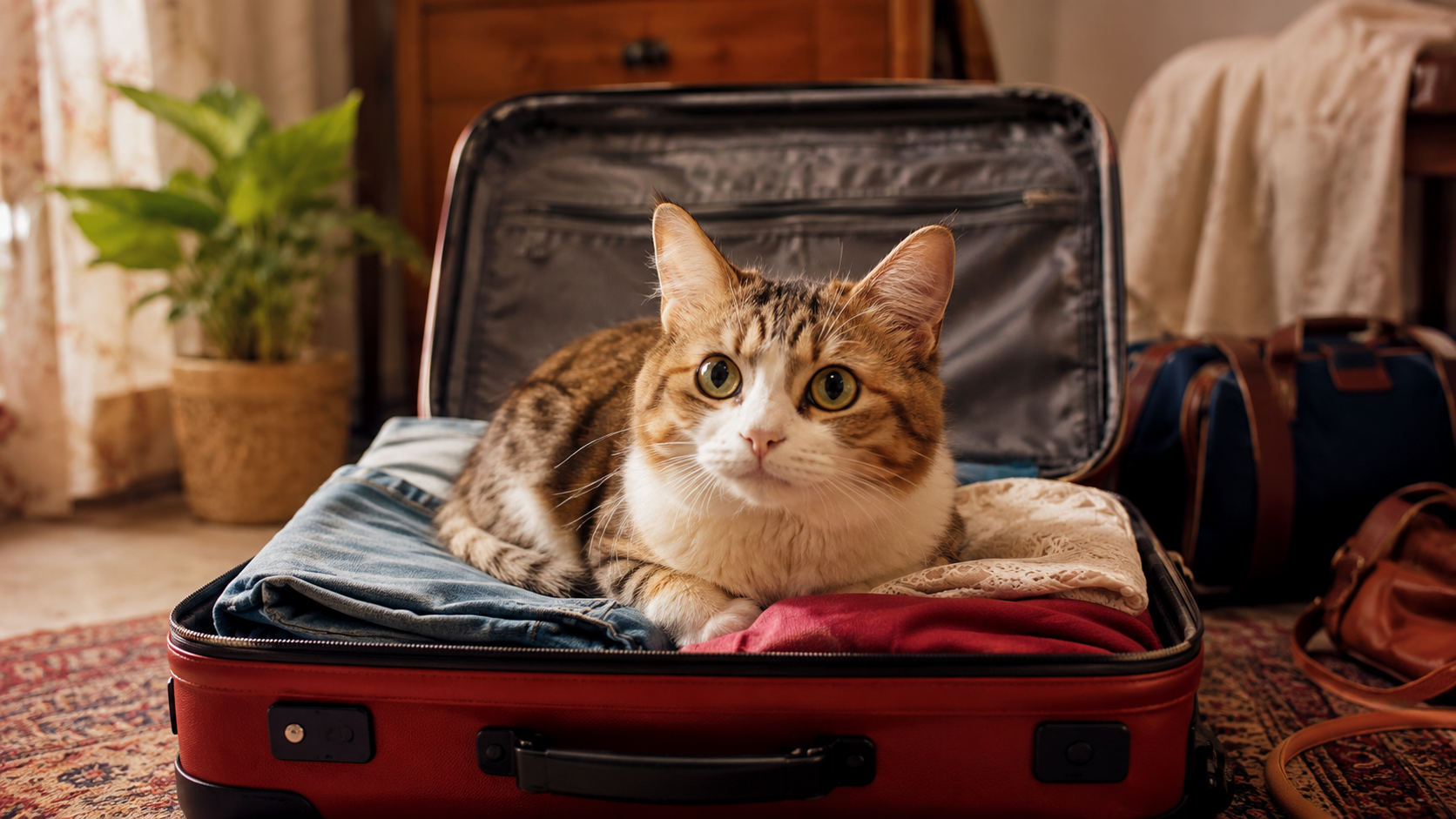
Finally, my brother unzipped the largest suitcase, red and shiny.
There she was.
Curled between the clothes, wide-eyed and still, looking as if to say, “If you are going, I am coming too.”
At first, it felt funny. A dramatic cat doing dramatic cat things.
But then it became a pattern.
Every time the suitcases came out, Luna changed. She became restless. She followed us from room to room. She meowed with urgency. She climbed into every open bag and refused to move until someone coaxed her out with treats.
Once, we tried taking her on a short car ride.
She howled the entire way. Her body trembled. She only calmed down when we brought her home.
It took us a while to understand that Luna was not being difficult.
She was anxious.
The first time we lost Luna, she was not really lost at all.
It was the night before a family trip. The house was in that familiar pre-travel chaos: half-folded clothes, open cupboards, overfilled bags, phone chargers being searched for, and someone shouting reminders from another room.
In the middle of it all, Luna disappeared.
We called her name. Lulu, for short. We rattled her food bowl. We checked under beds, behind curtains, inside cupboards and in all the quiet corners cats usually claim as their own.
Finally, my brother unzipped the largest suitcase, red and shiny.
There she was.
Curled between the clothes, wide-eyed and still, looking as if to say, “If you are going, I am coming too.”
At first, it felt funny. A dramatic cat doing dramatic cat things.
But then it became a pattern.
Every time the suitcases came out, Luna changed. She became restless. She followed us from room to room. She meowed with urgency. She climbed into every open bag and refused to move until someone coaxed her out with treats.
Once, we tried taking her on a short car ride.
She howled the entire way. Her body trembled. She only calmed down when we brought her home.
It took us a while to understand that Luna was not being difficult.
She was anxious.
Quick answer: Why do cats get anxious when you travel?
Cats can get anxious before travel because they are deeply attached to routine, scent, territory and familiar spaces. A suitcase, carrier, car ride or sudden change in the home can signal uncertainty or separation.
For some cats, especially rescue cats or cats who have experienced change before, travel may feel less like adventure and more like loss of safety.
Common signs of cat anxiety can include hiding, excessive meowing, following humans, refusing food, trembling, aggression, overgrooming, litter box changes, trying to escape or hiding inside bags and suitcases.
| Cat anxiety trigger | What it may mean to the cat |
|---|---|
| Suitcases | Change in routine or humans leaving |
| Carrier | Vet visit, travel or loss of control |
| Car ride | Loud sounds, motion and unfamiliar smells |
| Boarding | New territory and separation from home |
| New people | Unfamiliar scent and handling |
| Changed routine | Loss of predictability |
| Empty house | Separation from familiar humans |
This article is based on one pet parent’s lived experience and is not a substitute for veterinary advice. If your cat shows severe panic, appetite loss, aggression, breathing difficulty, repeated vomiting, sudden behaviour changes or ongoing stress, consult a veterinarian or qualified feline behaviour professional.
Meet Luna: The suitcase cat
Luna was not the kind of cat who liked surprises.
She loved her corners, her window, her blanket, her food bowl in the correct place and the couch that smelled like her people. She was not interested in adventure. She was interested in certainty.
To us, travel meant excitement.
To Luna, travel meant disruption.
Cats do not understand holidays the way humans do. They do not count days on a calendar or think in destinations. They understand the world through patterns: the smell of the room, the timing of food, the sound of footsteps, the warmth of a windowsill at a certain hour.
For Luna, the red suitcase was not luggage.
It was a warning.
It meant her people might leave. It meant the house might change. It meant her safe world might become uncertain.
Maybe cat fear is not stubbornness.
Maybe it is a longing for permanence.
Why cats hate sudden change
Cats are territorial animals.
Their sense of safety is closely tied to familiar spaces, familiar smells and predictable routines. When something changes suddenly, many cats become alert or stressed.
A suitcase may seem harmless to us, but to a cat it can signal a chain of changes:
- Clothes being moved
- Humans rushing around
- Unusual sounds
- Different schedules
- Food timing changes
- Pet parents leaving
- Strangers entering the home
- Boarding or travel
- Carrier stress
- Car rides
Cats are excellent at noticing patterns. If every suitcase appearance is followed by people leaving, a cat may start reacting as soon as the suitcase comes out.
This is why Luna climbed into bags.
She was not trying to be funny.
She was trying to stay close to what felt safe.
Signs your cat may have travel anxiety
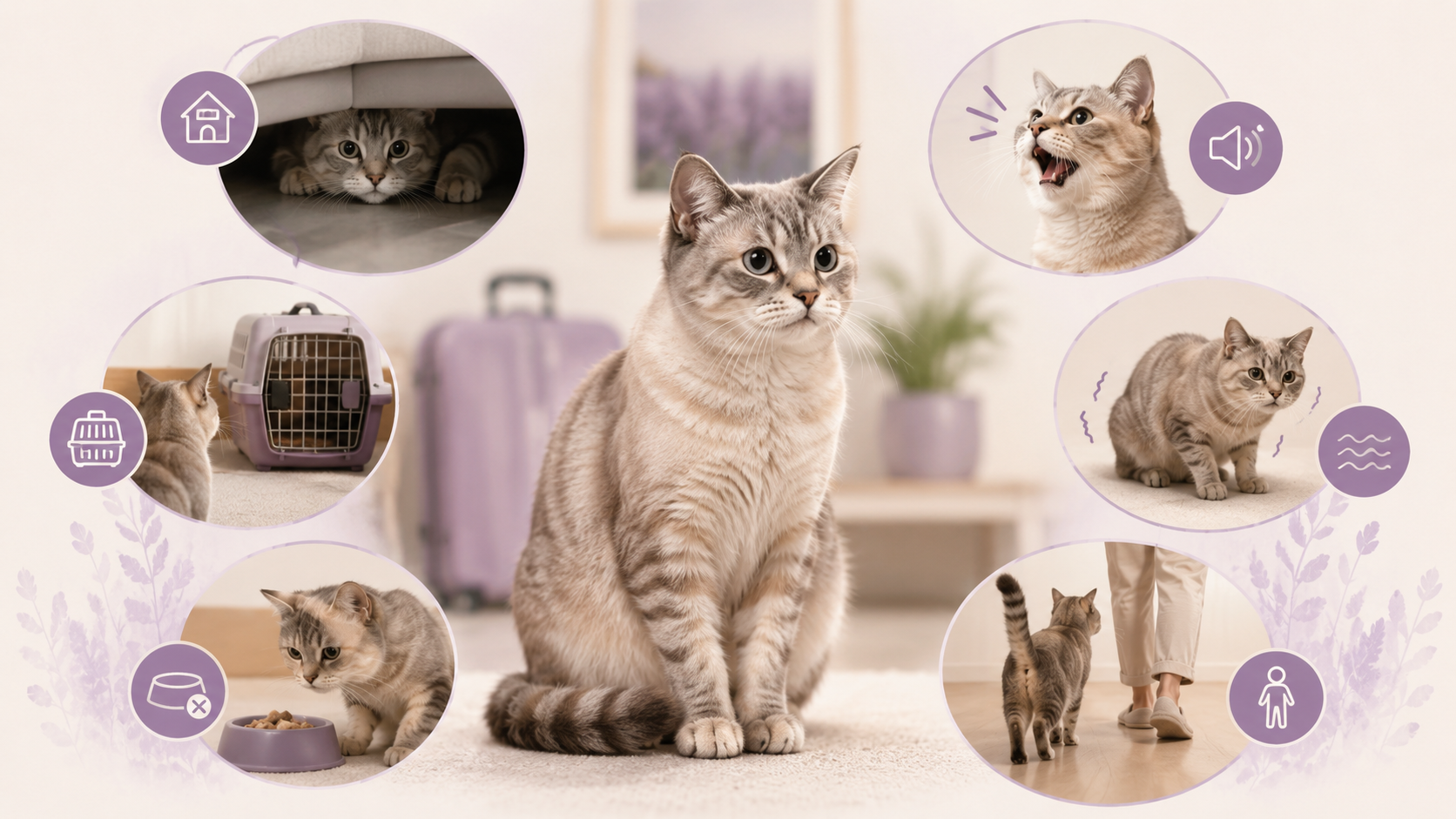
Cat anxiety can look different from cat to cat.
Some cats hide. Some become clingy. Some vocalise loudly. Some freeze. Some become defensive. Others stop eating or use the litter box differently.
Common signs of travel anxiety in cats include:
- Hiding under beds or inside cupboards
- Climbing into suitcases or bags
- Excessive meowing
- Following pet parents from room to room
- Trembling during car rides
- Refusing to enter the carrier
- Scratching or biting when handled
- Panting or drooling in extreme stress
- Refusing food
- Litter box changes
- Overgrooming
- Restlessness
- Trying to escape
In Luna’s case, the signs were clear once we understood them.
She became restless when bags appeared. She followed us anxiously. She climbed into luggage. She panicked during car rides.
The behaviour was not random.
It was communication.
Why rescue cats may feel travel stress more deeply
Rescue cats may be more sensitive to change because their world may already have shifted too many times.
A rescue cat may have experienced abandonment, relocation, shelter stays, foster homes, street life, medical stress or changes in caregivers.
This does not mean every rescue cat will be anxious. Many adjust beautifully.
But for some cats, sudden changes may reopen old fears.
A suitcase may feel like separation.
A carrier may feel like being taken away.
A new place may feel unsafe.
For Luna, whose sense of security depended on the home staying predictable, travel created a kind of emotional alarm.
The lesson was simple: before asking a cat to adapt, we first need to understand what the change means to them.
Why cat carriers can be stressful
Many cats only see the carrier before something stressful happens.
A vet visit. A car ride. A boarding stay. A move.
Over time, the carrier itself becomes a warning sign.
A cat who fears the carrier may:
- Hide when it appears
- Refuse to enter
- Spread their legs to resist being placed inside
- Scratch or bite
- Cry during travel
- Tremble inside
- Freeze completely
- Soil the carrier
One way to reduce carrier stress is to stop treating the carrier like an emergency object.
Let the carrier exist in the home sometimes. Keep it open. Add a soft blanket. Place treats near it. Let your cat explore it without being forced.
The goal is to make the carrier feel familiar before it is needed.
Why car rides are hard for many cats
Dogs may associate cars with parks, walks and outings. Cats usually do not.
For many cats, car rides mean motion, vibration, engine noise, traffic sounds, unfamiliar smells and loss of control.
Luna’s short car ride made this clear. She howled the entire way and trembled until she returned home.
Car anxiety in cats may be triggered by:
- Motion
- Loud traffic
- Strange smells
- Being confined
- Previous vet visits
- Separation from familiar territory
- Not knowing where they are going
For some cats, travel training can help slowly. For others, avoiding unnecessary travel may be kinder.
If travel is unavoidable, speak to a veterinarian about safe calming options and travel planning.
What did not work for Luna
Like many cat parents, we tried different solutions.
Cat boarding seemed practical, but Luna returned withdrawn.
Neighbours helped, but sometimes overfed her or forgot medicine.
Taking her along seemed emotionally comforting to us, but it was worse for her. Carriers, car rides, strange smells and unfamiliar spaces made her panic.
The problem was not that Luna did not want care.
The problem was that the care needed to happen in a way that respected her need for familiarity.
For some cats, the best travel solution is not taking them everywhere.
It is helping them feel safe at home while you are away.
What finally helped Luna feel safe
The answer was not dramatic.
It was gentle.
We hired a trusted cat sitter to visit daily.
The sitter refilled her bowls, checked on her, greeted her quietly and let Luna remain in the home she understood.
We kept her routine the same:
- Same food corner
- Same litter spot
- Same blanket
- Same resting places
- Same home smells
- Same quiet spaces
Slowly, Luna stopped associating luggage with panic.
She still noticed the suitcase. Of course she did.
But she no longer treated it like the end of her world.
This was the turning point.
Her home stayed still, even when ours moved.
Cat sitter vs cat boarding: Which is better for anxious cats?
For anxious cats, a trusted cat sitter is often better than boarding because the cat remains in a familiar environment.
Boarding may work for some cats, but for anxious cats it can involve too many changes at once: new smells, new sounds, new humans, other animals, different litter, different food timing and unfamiliar rooms.
| Option | Best for | Possible concern |
|---|---|---|
| Cat sitter at home | Anxious cats, senior cats, rescue cats, cats attached to routine | Requires a trusted person |
| Cat boarding | Cats comfortable in new spaces | Can be stressful for anxious cats |
| Taking cat along | Cats trained for travel | Carrier and car stress |
| Neighbour check-ins | Simple short trips | May lack consistency or medication care |
For Luna, a cat sitter was the best option because it preserved what she valued most: her home.
How to help an anxious cat when you travel
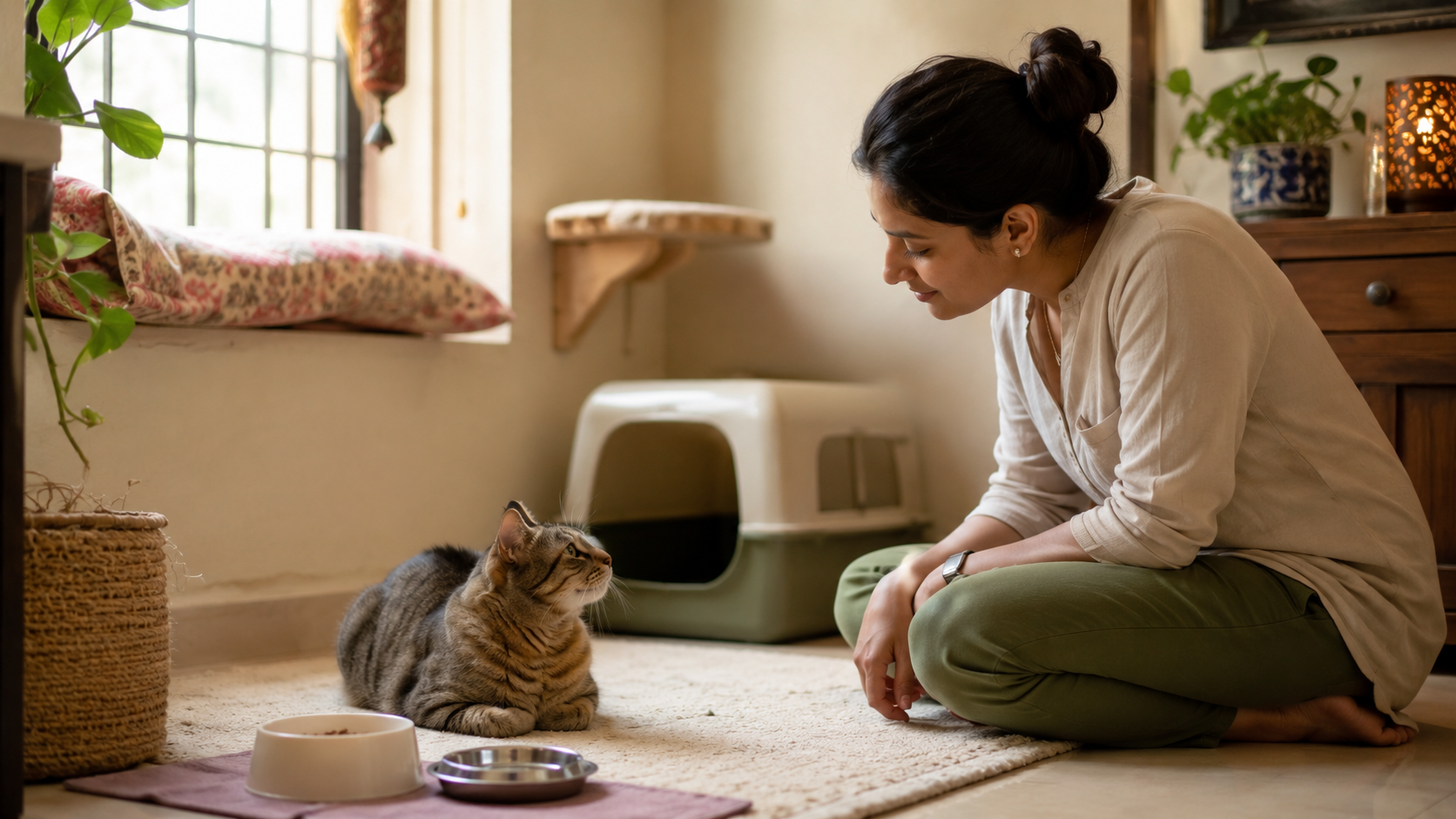
If your cat gets anxious before travel, focus on routine, predictability and familiar comfort.
Helpful steps include:
- Keep food and water in the usual place
- Keep the litter box in the usual spot
- Leave the favourite blanket or bed
- Avoid washing all familiar-smelling fabrics before travel
- Keep the carrier visible before travel if needed
- Use a trusted cat sitter if possible
- Leave clear feeding and medicine instructions
- Keep the home quiet and predictable
- Avoid last-minute chaos around the cat
- Give your cat safe hiding spaces
- Keep doors and windows secure
- Ask the sitter to send updates
Small things matter more than we think.
For a cat, a familiar blanket can be a promise.
Can calming sprays, CBD oil or Bach flower remedies help cats?
Some pet parents use calming sprays, CBD oil or Bach flower remedies for cats. In Luna’s case, small comforts like calming sprays, a drop of CBD oil on her blanket, or Bach flower remedy on restless days were part of the family’s calming routine.
However, calming aids should be used carefully.
Always consult a veterinarian before using CBD oil, supplements, flower remedies, sedatives or calming products for cats. Cats are sensitive animals, and not every product is safe or suitable for every cat.
Calming support should never replace proper care, routine, safety and veterinary advice.
The safest first steps are usually environmental:
- Keep routine stable
- Reduce noise
- Preserve familiar smells
- Use a quiet room
- Avoid forced handling
- Choose a trusted caregiver
- Keep the cat at home if travel is not necessary
If your cat has severe travel anxiety, speak to a vet before the next trip.
Should you take your cat with you when you travel?
Sometimes travel is unavoidable.
You may need to move homes, visit a vet, relocate cities or take your cat along for a long-term stay.
But for short holidays, many cats are more comfortable staying home with a trusted sitter than travelling with the family.
Before deciding, ask:
- Is the trip short or long?
- Is the destination cat-safe?
- Is the cat used to travel?
- Does the cat panic in the carrier?
- Will the cat have a quiet room there?
- Is there a vet nearby?
- Will the travel be worth the stress?
- Can a trusted sitter care for the cat at home?
For Luna, staying home was kinder.
Her version of comfort was not adventure.
It was continuity.
How to prepare a cat sitter for an anxious cat
A good cat sitter can make a huge difference, especially for an anxious cat.
Before leaving, prepare clear instructions.
Include:
- Feeding schedule
- Water routine
- Litter box cleaning instructions
- Medicine instructions, if any
- Favourite hiding spots
- Emergency vet contact
- Behaviour notes
- What not to do
- Door and window safety
- How to approach the cat
- Whether the cat likes touch or prefers distance
- Treat rules
- Update expectations
For anxious cats, the sitter should not force interaction.
Sometimes the best cat sitter is not the person who tries to be the cat’s best friend immediately. It is the person who respects the cat’s pace.
How music and quiet routines helped Luna
On some days, we asked the cat sitter to play soothing music for Luna.
It was a small thing. But small things can become signals of safety.
A familiar room. A familiar blanket. A quiet voice. A soft sound. A predictable bowl refill.
These repeated details told Luna:
This home is still yours.
Your people will come back.
Not every cat needs music, calming sprays or special rituals. But many cats benefit from a predictable environment.
The goal is not to distract the cat from your absence.
The goal is to reassure them that their world is not disappearing.
How Luna changed over time
Now, whenever the red suitcase appears, Luna no longer panics the way she used to.
She may still notice it. She may still perch on top of it with her tail tucked and her eyes bright.
But her message feels different now.
Not “Don’t leave me.”
More like, “I know you will come back.”
That is what trust looks like in a cat.
Not dramatic obedience.
Not instant adjustment.
Just the quiet confidence that the home will remain safe.
What Luna teaches cat parents
Luna taught us that cats are not stubborn for the sake of being stubborn.
They are sensitive to change.
They notice patterns.
They remember stress.
They ask for safety in ways humans may misunderstand.
A cat hiding inside a suitcase may look funny. But underneath the humour, there may be fear.
A cat howling in the car may not be difficult. She may be overwhelmed.
A cat withdrawing after boarding may not be ungrateful. She may be trying to recover.
Cat care becomes better when we stop asking, “Why is my cat behaving badly?”
And start asking, “What is my cat trying to tell me?”
What this story means to All Tails
At All Tails, we believe better pet care begins with listening.
That may mean noticing when a dog is anxious before grooming. It may mean understanding why a cat dislikes travel. It may mean recognising that a pet’s fear is not drama, but communication.
Luna’s story is a reminder that comfort looks different for every animal.
For some pets, comfort is a grooming session inside their own home instead of a salon.
For some cats, comfort is not being taken along on every trip.
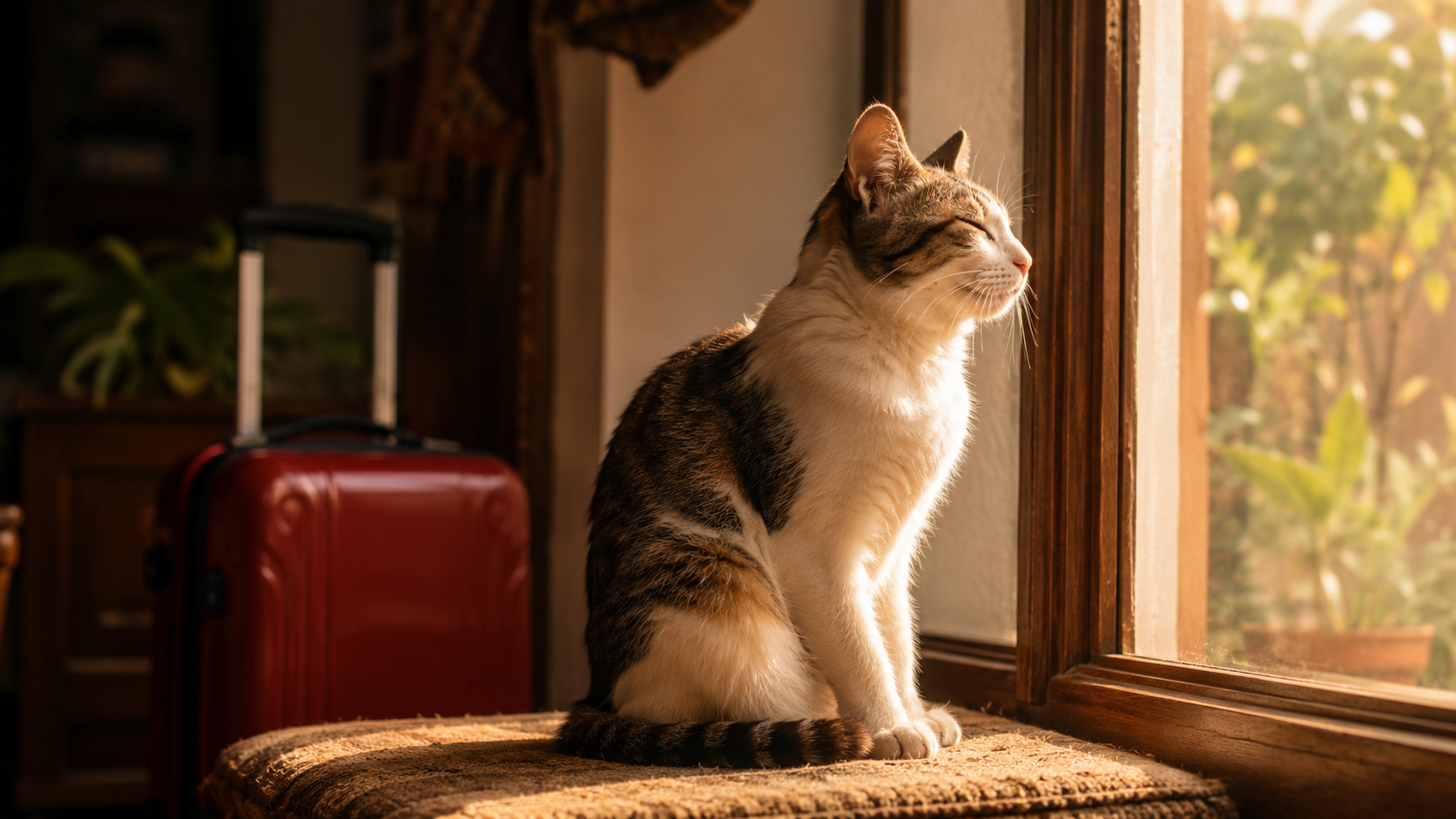
For Luna, comfort was simple: a warm windowsill, a familiar couch and the quiet promise that her home would stay just the way she left it.
Final thought: For cats, home is not just a place
Luna taught us that for cats, adventure can be overrated.
The greatest comfort is not always movement.
Sometimes it is the certainty of the same food corner, the same blanket, the same sunlit window and the same familiar couch.
Maybe that is true for us too.
Maybe all of us, in our own ways, want what Luna wanted.
A place that stays.
A world that feels safe.
And someone who always comes back.
Quick answers before you book
Why does my cat get anxious when I travel?
Cats can get anxious when you travel because they are attached to routine, scent, territory and familiar spaces. Suitcases, carriers, changed schedules and people leaving can signal uncertainty or separation.
Why does my cat sit inside my suitcase?
A cat may sit inside a suitcase because it smells like their human, feels like a safe enclosed space, or has learned that suitcases appear before people leave. It can be a sign of curiosity, attachment or anxiety.
What are signs of travel anxiety in cats?
Signs of travel anxiety in cats can include hiding, excessive meowing, trembling, refusing food, resisting the carrier, howling in the car, restlessness, aggression, overgrooming or litter box changes.
Are rescue cats more likely to have travel anxiety?
Some rescue cats may be more sensitive to change because they may have experienced relocation, abandonment or unstable environments. However, every cat is different.
Is a cat sitter better than cat boarding?
For anxious cats, a trusted cat sitter is often better than boarding because the cat can stay in a familiar home environment with the same food corner, litter spot and resting places.
Should I take my cat with me when I travel?
For short trips, many cats are more comfortable staying at home with a trusted sitter than travelling. If travel is unavoidable, prepare slowly and speak to a vet if your cat has severe anxiety.
How can I calm my cat before travel?
You can help calm your cat by keeping routines stable, leaving familiar blankets, making the carrier familiar, reducing noise, using a trusted sitter and avoiding last-minute chaos around the cat.
Can calming sprays help cats with anxiety?
Some calming sprays may help some cats, but results vary. Always choose cat-safe products and consult a veterinarian if your cat has severe anxiety or if you plan to use supplements, CBD oil or remedies.
Is CBD oil safe for cats?
CBD oil should only be used for cats after consulting a veterinarian. Cats are sensitive, and not every product or dosage is safe.
Why does my cat hate the carrier?
Many cats hate the carrier because they associate it with vet visits, car rides or stressful travel. Keeping the carrier visible at home with a blanket and treats can help make it feel less threatening over time.
How can I prepare a cat sitter for an anxious cat?
Give the sitter clear instructions about feeding, water, litter, medicine, hiding spots, emergency vet contacts, door safety and how your cat prefers to be approached.
What does Luna’s story teach cat parents?
Luna’s story teaches that cat anxiety is not stubbornness. It is often a request for routine, safety and reassurance. Cats communicate stress through behaviour, and pet parents need to listen.
Our editorial team consists of professional pet groomers and pet-care researchers who write clear, practical guides based on real grooming sessions across Delhi NCR, Chandigarh Tricity, and Dehradun.
Leave the grooming to us.
Trained groomers at your home — packages from ₹999. Pay online or after the session.
More guides in the same flow
What an African Grey Parrot Taught Us About Exotic Pet Care in India
Michelle the African Grey parrot was never just a pet. Her story is a moving reminder that exotic pet care in India requires patience, better diet, avian vet care, social learning and the humility to keep learning from the animals we love.
Open guide
Rover’s Secret Children: Why Neutering Matters
Rover was a loved Labrador who always came home after his evening adventures. But somewhere in the city, his puppies were born into cardboard boxes and uncertain futures. This story asks pet parents to rethink freedom, masculinity and the responsibility of neutering.
Open guide
The Goldfish Who Wouldn’t Swim Straight: What Mochi Taught Us About Fish Care
Mochi the goldfish came home as a birthday surprise and soon began swimming sideways. His story is a funny, tender reminder that goldfish are not decor — they are living pets who need proper food, clean water and real care.
Open guide