The Dog Who Waited on a Scooter: A Story About Pet Abandonment, Trust and Responsibility
She waited on a scooter because she thought her humans were coming back. This story is a reminder that pets do not understand abandonment — they understand trust, routine and the promise of return.
Clear answers, fixed package context, and grooming advice that matches how pet parents actually search before booking.
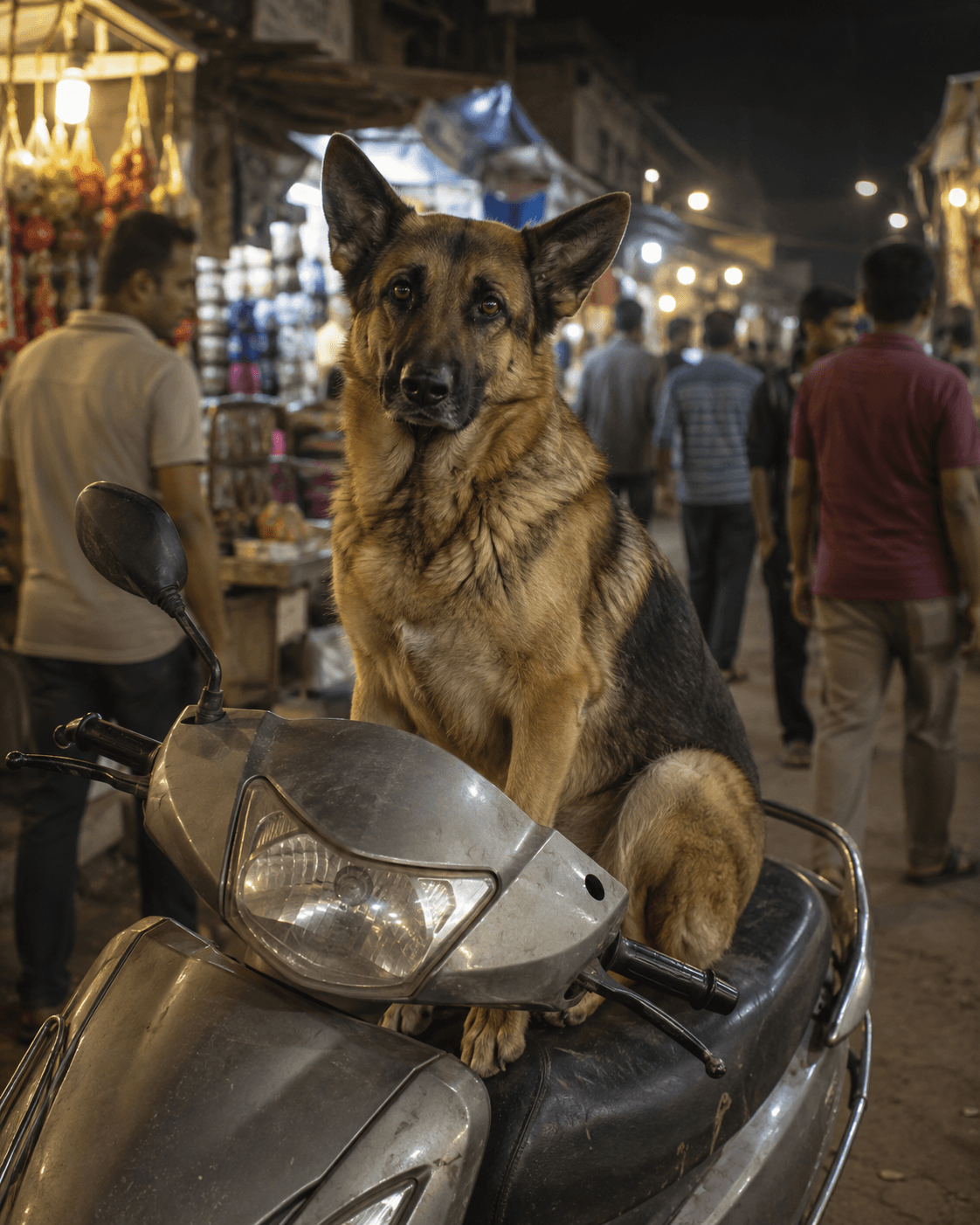
She did not know she had been abandoned.
She only knew the scooter had brought her there.
So she waited.
In a crowded Delhi market, while people walked past, shop shutters moved, scooters came and went, and the evening slowly turned colder, a German Shepherd reportedly stayed on a parked scooter for hours.
Maybe she recognised the smell of the seat.
Maybe she remembered the sound of the engine.
Maybe she thought the person who brought her there had stepped away for just a minute.
Dogs are very good at waiting.
They wait near doors. They wait at windows. They wait beside food bowls, under dining tables, outside bathrooms and near parked vehicles. They wait because, most of the time, waiting works.
The door opens.
The hand returns.
The familiar voice calls their name.
The person comes back.
That is what makes this story hurt.
She waited because she trusted.
She did not know she had been abandoned.
She only knew the scooter had brought her there.
So she waited.
In a crowded Delhi market, while people walked past, shop shutters moved, scooters came and went, and the evening slowly turned colder, a German Shepherd reportedly stayed on a parked scooter for hours.
Maybe she recognised the smell of the seat.
Maybe she remembered the sound of the engine.
Maybe she thought the person who brought her there had stepped away for just a minute.
Dogs are very good at waiting.
They wait near doors. They wait at windows. They wait beside food bowls, under dining tables, outside bathrooms and near parked vehicles. They wait because, most of the time, waiting works.
The door opens.
The hand returns.
The familiar voice calls their name.
The person comes back.
That is what makes this story hurt.
She waited because she trusted.
Quick answer: Why do abandoned dogs wait for their owners?
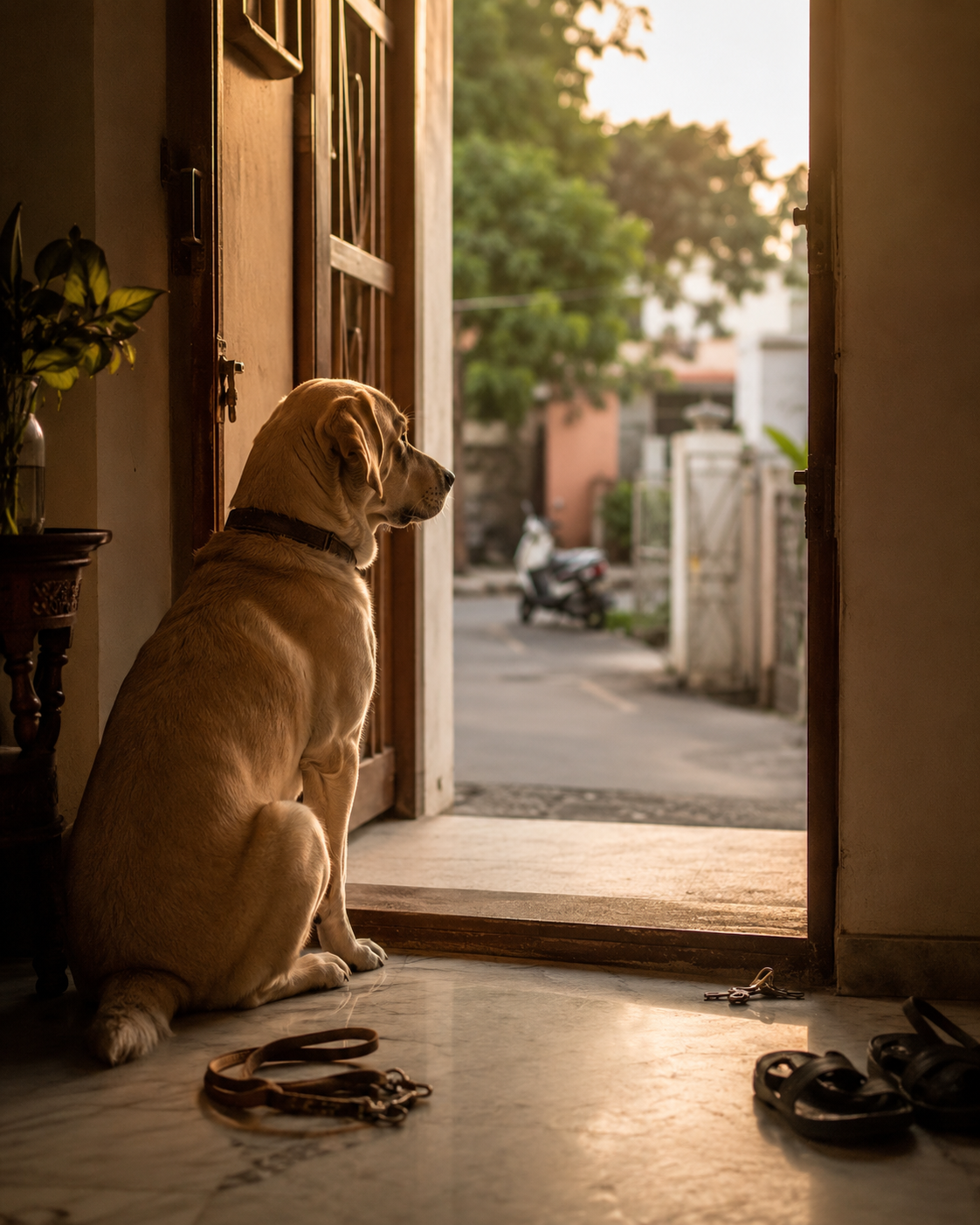
Abandoned dogs may wait for their owners because they are attached to familiar people, vehicles, smells, routines and places. Dogs do not understand abandonment the way humans do. If a pet has learned that their human usually returns, they may keep waiting even after being left behind.
A dog who waits after abandonment is not being foolish. The dog is responding to trust, routine and attachment.
| Behaviour | What it may mean |
|---|---|
| Waiting near a vehicle | The dog may associate the vehicle with their human |
| Refusing to leave a spot | The dog may believe the owner will return there |
| Looking at passersby | The dog may be searching for a familiar face |
| Climbing onto a scooter or car | The dog may be seeking the last familiar smell |
| Staying silent or alert | The dog may be confused, stressed or waiting |
| Following strangers | The dog may be seeking help or familiarity |
This article is inspired by a reported incident of an abandoned German Shepherd in Delhi. It is written as a pet-care story about trust and responsibility, not as a direct witness account.
The scooter, the market and the eight-hour wait
Imagine a dog in a market.
Not a street dog born into the chaos of passing feet and food stalls.
A pet dog.
A German Shepherd.
A dog who likely knew humans, vehicles, touch, commands, mealtimes and the familiar geography of a home.
Now imagine that dog on a scooter.
Still.
Watching.
Waiting.
Around her, the market continued. People bargained. Horns sounded. Someone bought vegetables. Someone rushed home. Someone noticed. Someone recorded. Someone worried.
But the dog stayed.
That is the thing about abandonment. To humans, it may happen in a moment. To the animal, it stretches.
Minute after minute.
Sound after sound.
Face after unfamiliar face.
A pet does not know that a decision has been made. A pet does not understand that someone has chosen not to return. A pet only understands the last known promise.
Stay here.
I will come back.
Even if that promise was never spoken, dogs hear it in routine.
Dogs do not understand abandonment the way humans do
Humans understand explanations.
We understand rent problems, family conflict, relocation, illness, job loss, fear, inconvenience and regret.
Dogs do not.
A dog does not understand why the home is gone.
A dog does not understand why the person they trusted walks away.
A dog does not understand why a market is suddenly supposed to become a life.
They understand scent.
They understand tone.
They understand footsteps.
They understand the sound of keys.
They understand the vehicle that takes them somewhere and, usually, brings them back.
That is why abandonment is not just physical danger.
It is emotional confusion.
A pet left behind is not “set free.”
A pet left behind is placed into a world they were not prepared to survive.
Pet abandonment is not relocation
Sometimes people soften the word.
They say the pet was “left.”
They say the pet was “released.”
They say the pet was “dropped.”
They say the pet will “manage.”
But abandonment is not relocation.
Relocation has planning.
Rehoming has responsibility.
Rescue has communication.
Abandonment has silence.
A pet who has lived inside a home may not know how to find food, avoid traffic, stay safe from aggressive animals, protect themselves from weather, trust the right humans, avoid cruelty, or survive fear.
A dog abandoned in a market is not beginning a new independent life.
The dog is losing the only structure they understood.
Why people abandon pets
Pet abandonment rarely happens because a person woke up one day and decided to become cruel. Sometimes it happens because people are overwhelmed. Sometimes because they were never prepared. Sometimes because they treated pet ownership as a temporary emotion.
Common reasons people abandon pets include:
- Moving homes
- Landlord restrictions
- Financial pressure
- Behaviour problems
- Medical expenses
- Family objections
- New baby or life changes
- Lack of time
- Old age or illness in the pet
- Shedding, barking or cleanliness concerns
- Buying or adopting without understanding responsibility
These reasons may explain pressure.
They do not excuse abandonment.
A pet is not a product that stops being ours when life becomes inconvenient.
A pet is a dependent life.
The difference between rehoming and abandoning
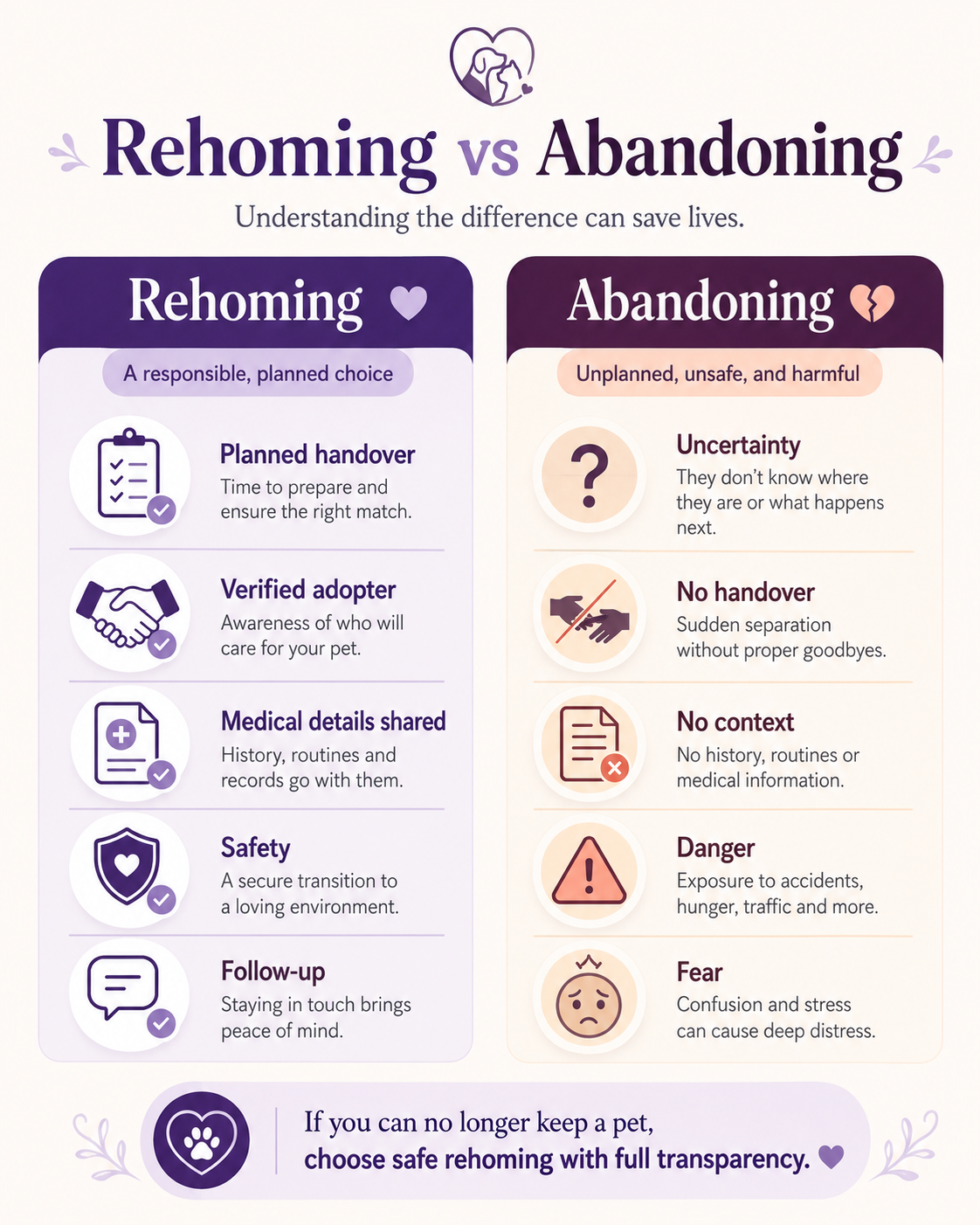
There is a responsible way to say, “I cannot care for this pet anymore.”
It is not easy.
It may be painful.
It may involve uncomfortable conversations.
But it exists.
Rehoming means making sure the animal moves from one safe situation to another safe situation.
Abandoning means leaving the animal to uncertainty.
| Rehoming | Abandoning |
|---|---|
| Planned | Sudden |
| Safe handover | No handover |
| Verified adopter or rescue | Unknown outcome |
| Medical and behaviour details shared | No context |
| Follow-up possible | No accountability |
| Pet’s safety considered | Pet left vulnerable |
If you cannot keep a pet, ask for help early. Speak to trusted friends, family, verified rescuers, animal welfare groups, foster networks or veterinarians.
Do not wait until panic turns into abandonment.
What to do if you can no longer care for your pet
If you are struggling to care for your pet, the first step is not shame.
The first step is honesty.
Ask yourself what the real problem is.
Is it money?
Time?
Behaviour?
Housing?
Medical care?
Family pressure?
Travel?
Many problems have solutions if you ask for help early enough.
Responsible steps include:
- Speak to a veterinarian if the issue is medical or behavioural
- Ask trusted friends or family if they can help temporarily
- Contact verified animal welfare groups
- Look for a responsible foster
- Screen potential adopters carefully
- Share vaccination and medical details
- Share behaviour history honestly
- Do not hide aggression, anxiety or illness
- Avoid giving the pet to random strangers without checks
- Never abandon the pet in a market, park, road or shelter gate
A difficult rehoming conversation is still better than a silent abandonment.
What to do if you find an abandoned dog
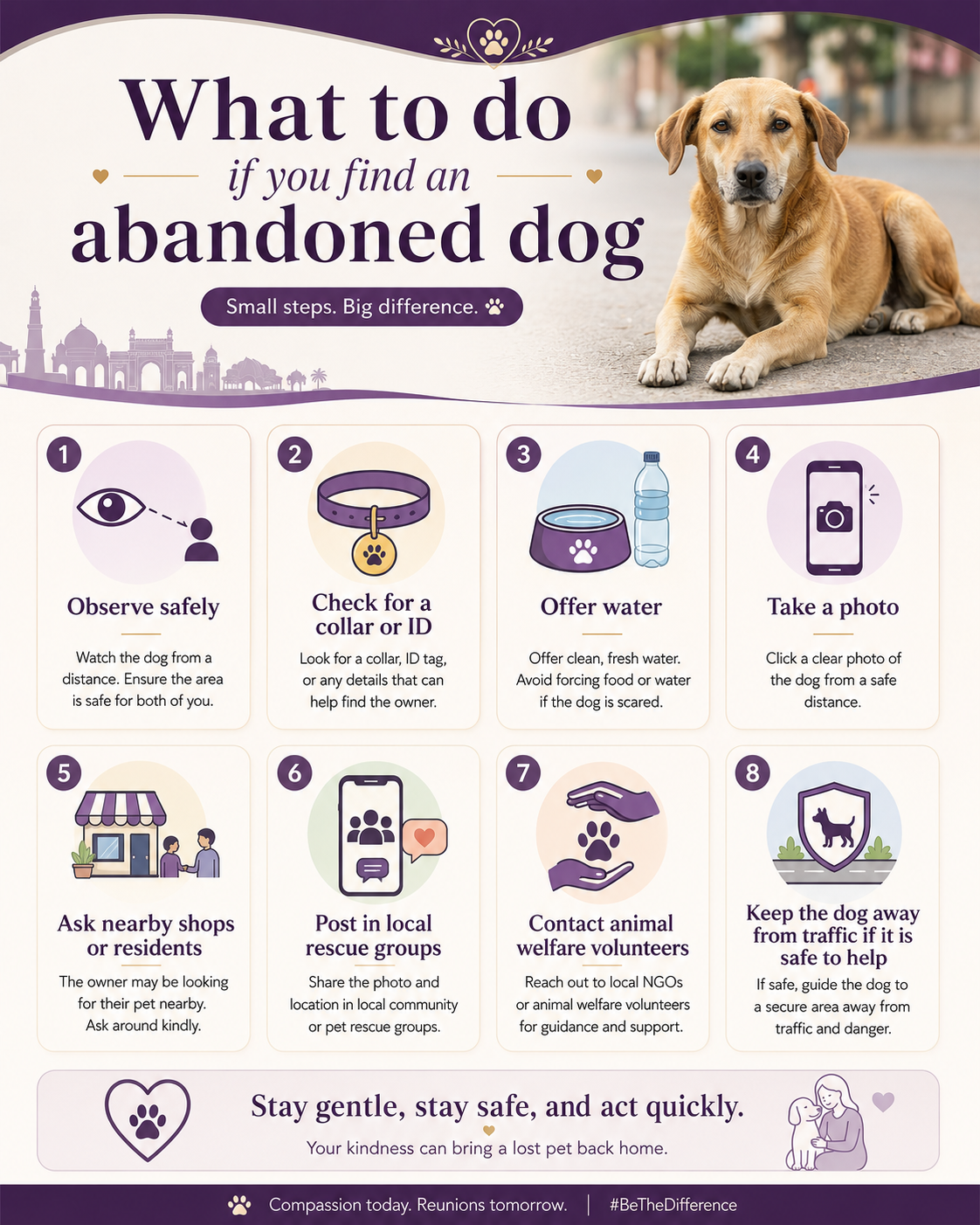
If you find a dog who appears abandoned, scared or waiting in one place, act carefully.
Do not rush at the dog.
Do not grab suddenly.
Do not crowd the animal.
The dog may be frightened, confused, defensive or injured.
Helpful steps include:
- Observe from a safe distance
- Check whether the dog is wearing a collar or tag
- Offer water if safe
- Avoid sudden movements
- Take photos and videos for identification
- Ask nearby shops or guards if they saw the owner
- Post in local animal rescue and lost-pet groups
- Contact nearby animal welfare volunteers
- Check with local vets and shelters
- If safe, keep the dog away from traffic
- Do not relocate the dog far away without rescue guidance
If the dog is injured, aggressive, very scared, or in danger, contact local animal rescue volunteers or a veterinarian for guidance.
Why rescuers and volunteers matter
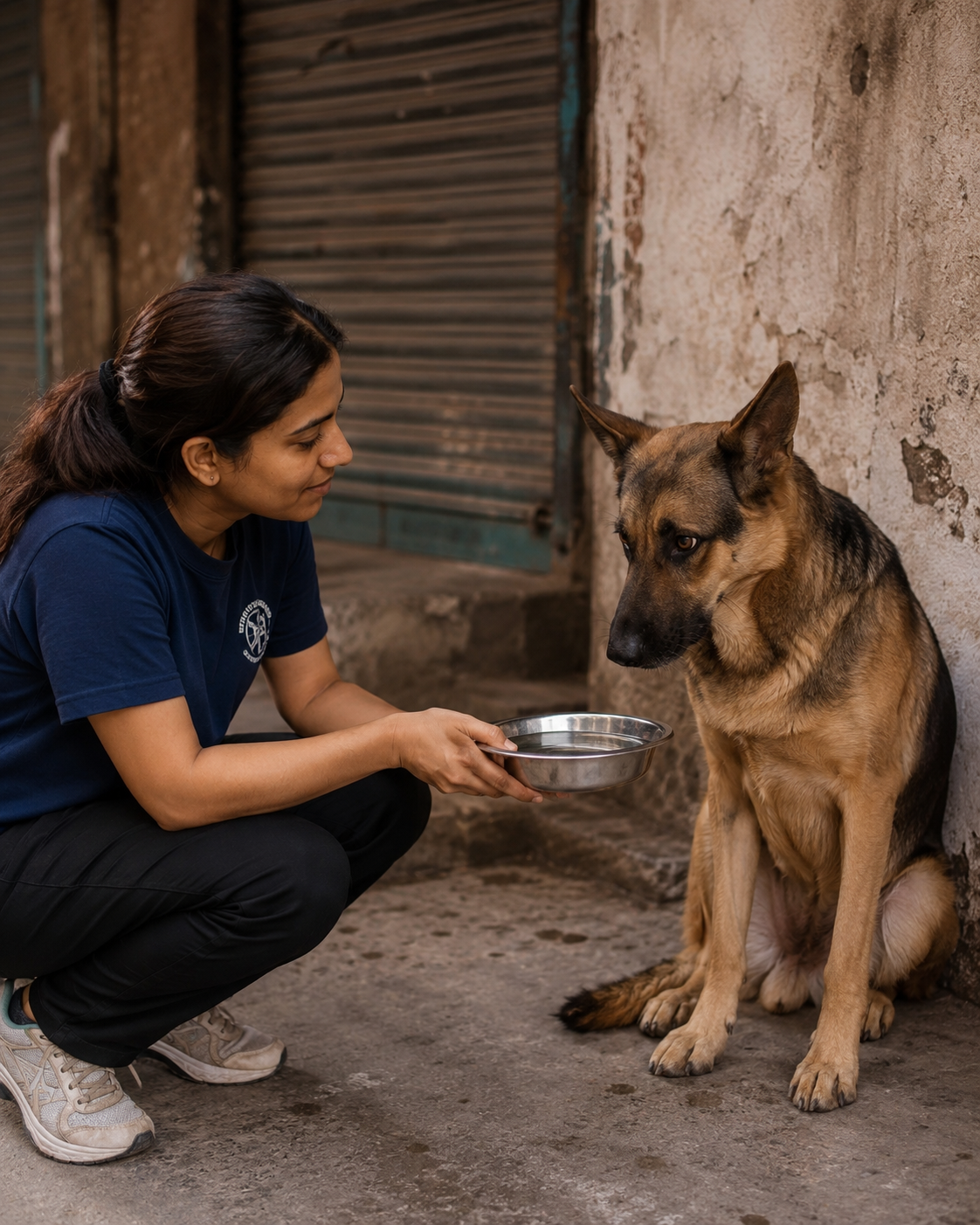
In stories like this, there is always a second kind of waiting.
The dog waits for the person who left.
The rescuers wait for help, transport, shelter space, updates, replies, one more volunteer, one more call that gets picked up.
Animal rescue is not magic.
It is people staying awake late, coordinating vehicles, sharing posts, calming animals, paying bills, finding fosters and doing the emotional work most people only see after it becomes a viral post.
When an abandoned dog is rescued, it is not just because the internet cared.
It is because someone physically showed up.
Compassion becomes real when it moves.
Why this story went viral
This story hurt people because it was easy to see.
A dog on a scooter.
A familiar object.
A simple act of waiting.
No complicated explanation was needed.
Most pet parents have seen their dog wait for them. Outside a bathroom. Near a gate. At the sound of a lift. Beside a parked car.
So when people saw a dog waiting on a scooter, they understood immediately.
The scooter became a symbol.
Not of transport.
Of trust.
She stayed with the last familiar thing she had.
That is why the image stayed with people.
The real question this story asks
The question is not only, “How could someone do this?”
That question matters, but it is not enough.
The bigger question is:
What do we owe the animals who trust us?
We owe them food, yes.
We owe them shelter, yes.
We owe them medical care, grooming, safety and kindness.
But we also owe them continuity.
We owe them not to disappear without explanation.
We owe them not to make them pay for our lack of planning.
We owe them the dignity of a safe handover if we cannot continue.
A pet is not a phase.
A pet is not a birthday surprise that can be returned to the street.
A pet is not a problem to be dropped somewhere else.
A pet is a promise.
Responsible pet ownership begins before adoption
Many abandonment stories begin long before the pet is left behind.
They begin when someone brings home a pet without asking the hard questions.
Before bringing home a dog, ask:
- Can I care for this pet for the next 10 to 15 years?
- Can I afford food, grooming, vaccines and medical care?
- Is my housing pet-friendly?
- What will happen if I move?
- Who will care for the pet when I travel?
- Can I manage shedding, barking, training and exercise?
- Can I care for the pet if they become old or sick?
- Is everyone in the family prepared?
- Am I choosing a pet or an aesthetic?
- Do I understand the breed’s needs?
Love is not enough if it is not supported by planning.
The most loving pet parents are not the ones who feel the strongest emotion on day one.
They are the ones who keep showing up on day one thousand.
What this story means to All Tails
At All Tails, we believe pet care begins with listening.
Sometimes that means understanding why a dog is anxious before grooming.
Sometimes it means recognising that a cat is not being dramatic about travel.
Sometimes it means seeing that a pet waiting in one place may not be stubborn, but heartbroken.
The dog on the scooter reminds us that animals build their worlds around us.
Our voices.
Our routines.
Our vehicles.
Our doors.
Our return.
When we break that trust, they do not understand the reason.
They only feel the absence.
Final thought: They wait because they trust us
She waited because waiting had always made sense.
Because humans leave and return.
Because scooters stop and start.
Because familiar smells mean safety.
Because a dog’s heart does not immediately understand betrayal.
That is why this story should not end only with outrage.
It should end with responsibility.
If you cannot care for a pet, ask for help.
If you see an abandoned animal, do not look away.
If you are planning to bring home a pet, understand the promise before the excitement.
And if an animal waits for you, become worthy of that waiting.
They wait because they trust us.
Let us become worthy of that trust.
Quick answers before you book
Why do abandoned dogs wait for their owners?
Abandoned dogs may wait for their owners because they are attached to familiar people, vehicles, smells and routines. If a dog has learned that their human usually returns, they may keep waiting even after being left behind.
What should I do if I find an abandoned dog?
Observe from a safe distance, check for a collar or tag, offer water if safe, ask nearby people for information, take photos, post in local rescue groups and contact animal welfare volunteers or a veterinarian for guidance.
Is abandoning a pet the same as rehoming?
No. Rehoming is a planned and responsible process where the pet is safely handed over to a verified person, foster or rescue. Abandoning means leaving the pet without safety, context or accountability.
Why do people abandon pets?
People may abandon pets because of relocation, financial stress, behaviour problems, medical expenses, family pressure or lack of planning. These pressures may explain the situation, but they do not justify abandonment.
What should I do if I can no longer care for my pet?
Ask for help early. Speak to trusted family, friends, veterinarians, verified rescuers or animal welfare groups. Share medical and behaviour details honestly and never leave the pet in a public place.
How can pet abandonment be prevented?
Pet abandonment can be reduced through responsible adoption, better planning, pet-friendly housing decisions, behaviour support, sterilisation, medical care awareness and verified rehoming options.
Is it safe to approach an abandoned dog?
Approach carefully. A scared or confused dog may bite or run into traffic. Avoid sudden movements and contact local rescue volunteers if the dog seems frightened, injured or aggressive.
What are signs that a dog may have been abandoned?
A dog may appear confused, stay in one place for a long time, look for someone, refuse to leave a vehicle or spot, seem stressed, follow strangers or appear well-groomed but lost.
Why is pet abandonment emotionally harmful?
Pets form attachments to their humans and routines. Abandonment can cause fear, confusion, stress and trauma because the animal does not understand why their familiar person did not return.
What does the dog on the scooter story teach pet parents?
The story teaches that pets trust humans deeply. If a pet parent cannot care for a pet anymore, they must rehome responsibly instead of abandoning the animal.
Our editorial team consists of professional pet groomers and pet-care researchers who write clear, practical guides based on real grooming sessions across Delhi NCR, Chandigarh Tricity, and Dehradun.
Leave the grooming to us.
Trained groomers at your home — packages from ₹999. Pay online or after the session.
More guides in the same flow
Dog Grooming at Home: Cost, Process, Packages & Booking Guide
Everything pet parents need to know about All Tails dog grooming at home, including prices, package inclusions, process and booking.
Open guideProfessional Dog Grooming vs DIY Grooming at Home: Which Is Better?
Learn when simple DIY grooming is enough and when professional at-home dog grooming is safer and more effective.
Open guide
What an African Grey Parrot Taught Us About Exotic Pet Care in India
Michelle the African Grey parrot was never just a pet. Her story is a moving reminder that exotic pet care in India requires patience, better diet, avian vet care, social learning and the humility to keep learning from the animals we love.
Open guide